
Writing Poetry

It’s January! Poetry Month as recognized by many writers who try to write a poem a day this month.
Many publishing houses refuse to accept manuscripts written in rhyme. The reason for this is that few authors understand what it takes to write good rhyming poems.
I recall my first attempts to write poems when I was in high school, and it still makes me laugh when I think about them. My writing adventure started when a classmate passed a poem to me that she and her mother had written the previous evening. I added a few more lines and I was hooked. It was fun – until I shared my poems with my father who also taught high school English. He pointed out so many flaws in that very long poem that I decided writing poems was too hard. I stopped trying to write them.
Forty years later my husband insisted I write a poem to include with a wedding gift for a friend. I kept saying I could not write poetry, but he kept insisting that I could. Finally, to get him off my back, I started to write. I came up with a train of thought that worked, and somehow a three-stanza poem came together. I remembered the kinds of things my father had criticized in my earlier poems, and I focused on avoiding those type of mistakes. My friend was so impressed with my poem that she had it framed and hung it on her wall.
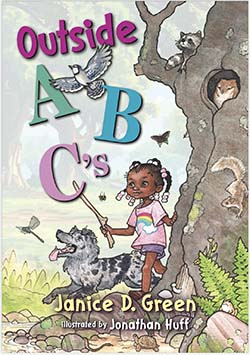
Writing poems was fun again, and I began writing poems for an alphabet book about nature. My poems were still not fully polished, but my father was impressed. I put them into a book and printed them out on my computer with illustrations my mom painted. I carried my book to a writing conference where I shared it with Crystal Bowman, a multi-published author and poet. She encouraged me with what I was doing and agreed to mentor me. After some time, a new and improved book came out of our efforts, and now we are eagerly awaiting the upcoming release of my book, Outside ABCs, illustrated by my grandson, Jonathan Huff. It is being published by Ambassador International.
As an elementary school librarian, I taught a few classes how to write poems. I thought I might share a couple of tips that might help other wannabe poets try their hand at it.
Some very basic things need to be understood about writing poems.
Rhyming words must fit the message of your poem. Never stick a word at the end of the line just because it rhymes. I threw together this silly poem to make my point. The rhyming words pulled the poem, but the poem is basically meaningless and going nowhere.
Feet
My feet take me where I want to go
My heels always follow my toes
Where am I going? I don’t know
Because I just go where I go
Poems also need a strong sense of rhythm or meter. The above example does not have good meter. Every line has a different beat to it. One method to get the feel of meter is to try to write your poem to fit the tune of a song you know. Poems written for children need the simplest meter. Consider the exact meter in this very familiar song:
Jesus loves me this I know
For the Bible tells me so.
Little ones to Him belong.
They are weak, but He is strong.
Every line has the very same rhythm. An accent beat followed by a non-accented beat repeated three times followed by an accent beat. ^-^-^-^
Before starting to write a poem, choose a topic and brainstorm a list of words that go with that topic. For example, if you wanted to write a poem about a kitten, your list of words might include:
Kitten, fur, whiskers, tail, paws, purr, play, sleep, jump, eyes, nose, claws, toy, pounce, run, tumble, bat, the kitten’s name . . . I had a kitten named Inky once. I’ll try my hand at writing a short poem about Inky. I’ll try to fit it to the tune Jesus Loves Me
Inky had the softest fur
How I loved to hear her purr
She would run and jump and play
Bat her toys . . .
It is easy to get stuck. I could force it to rhyme by saying she would sleep all day, but that wouldn’t fit what really happens. So, I need to re-think the last two lines. I cannot think of a good match for play. Maybe . . .
She would pounce and jump and run
Every day with her was fun
OK. That works. Sometimes you just need to back up a few lines and start over.
Inky had the softest fur
How I loved to hear her purr
She would pounce and jump and run
Every day with her was fun.
This poem won’t win any poetry contests. It still doesn’t capture the warm cuddly kitten to make you love her. There are so many more techniques poets use as they select words that can capture the energy and feelings of a child and her precious kitten.
There are other types of poetry besides those that rhyme. The beauty of these poems is in their simplicity and their unique rhythm patterns. There are books and online resources to teach more about writing poetry. I once joined a website at www.writing.com where I tried writing several different types of poems.
It was fun to write my little poem, even though it isn’t a masterpiece. Perhaps I will work with it some more another time. I encourage our readers to try their hand at writing a simple poem and share it in the comments below.
Photo by Hannah Olinger on Unsplash
Be sure to sign up to receive updates of each new post on our Christian Children’s Authors blog. Follow us for new book news, free resources, parenting tips, and encouragement!
#christianchildrensbooks #christianhomeschool #christianchildrensauthors